Tuesday, August 15, 2023

Who Did You Vote For, Canada?

The disintegration of Canada didn't happen from nothing:

It’s easy to pass off the series of high-profile murders and random attacks that have been witnessed recently as anecdotal evidence. Like the two notable videos of men bleeding out in the wake of knife attacks — one in Vancouver and another in Toronto. The former shows a father dying in front of a coffee shop; the latter shows a bleeding man running away from his attacker in a subway car, screaming, only to be cornered (fortunately, he survived).

By themselves, these graphic recordings are merely anecdotal evidence of rising crime and urban disorder. Statistics show, however, that each video forms the tip of a very real iceberg of lawlessness that began growing after 2014.
The most recent data drop by Statistics Canada reveals a number of haunting figures: the homicide rate has risen for the fourth consecutive year and is now at its highest level since 1992 (largely due to more gang violence); the rate of violent gun crime has risen for the eighth consecutive year; per capita victims of violent crimes involving firearms has increased 60 per cent since 2013; fraud is roughly twice as prevalent as it was 10 years ago, and extortion is five times higher.

Article content

Rates for some types of violent crime (serious sexual assaults, for example) and property crime remained stable, but overall, the evidence shows that Canada is a more violent place than it was a decade ago. And in many cities, the situation is becoming untenable.
Toronto’s sharp rise in crime has residents on edge: a survey released earlier this year by Abacus Data showed that crime was one of Torontonians’ top concerns. The city’s transit system has experienced a dramatic spike in crime that includes stabbings, swarmings, arsons and firework detonations.
In Vancouver, persistent theft and violence has some businesses giving up entirely. In Edmonton, stabbings are now a periodic occurrence at transit stops; homeless encampments, meanwhile, are popping up so fast, the city can’t even keep up on its risk assessments. Reports from Newfoundland — which experienced one of the steepest rises in crime last year — reveal a growing sense of fear and abandonment among those living in St. John’s downtown core.
The key event that occurred around the time that violent crime began to rise was the election of Prime Minister Justin Trudeau, who promised a soft-on-crime approach and leniency toward offenders. Instead of locking criminals in cages, he intended to use a free-range approach.

Article content

Trudeau entered office with a warm reception from the experts on call at the CBC, who referred to the tough-on-crime approach of his Conservative predecessors as “incoherent,” and drawing from an “ideological grab bag of repression and meanness.”
Under former prime minister Stephen Harper, laws were introduced to create mandatory minimum sentences for specific offences, creating democratically set floors on criminal punishment, and to make it harder for judges to sentence certain offenders to house arrest.
The Parole Board of Canada was given more latitude to consider the severity of a criminal’s actions when deciding whether to grant a release. The ability to pardon serious offenders was eliminated. Harper also made it easier for officers to arrest offenders who seemed to be breaching their release conditions, and it was made more difficult for those who had committed multiple murders to be paroled.
The general aim was to keep violent and repeat offenders off the streets and behind bars. The necessity of such measures is now clear for all to see, as municipalities across the country witness large numbers of crimes committed by a small number of chronic offenders, while murders and other violence offences are committed by criminals who are out on bail or statutory release.

Article content

Although many of the Harper-era criminal justice reforms were eventually struck down by the courts, the Trudeau Liberals have consistently gone a step further: introducing laws to repeal a host of mandatory minimum sentences; instructing police and courts to favour release over detention; mandating that Correctional Services of Canada place inmates in “the least restrictive environment”; and repealing other Conservative reforms that the courts had not taken exception to.
Instead of pushing back against the courts’ loose approach toward granting bail, the Liberals codified it into law. Instead of ensuring drug addicts get the treatment they need while preventing them from harming others, they’ve permitted the decriminalization of illicit drugs — and even hand them out for free, which has fuelled the black market.
Justice Minister Arif Virani believes that rising crime is just an illusion — but for anyone with a view of their city’s streets, it’s all too real. Until our leaders recognize the increase in crime that has become painfully obvious to the vast majority of Canadians, our cities will continue to descend into lawlessness. We may have a new justice minister, but Canadians should not expect more justice.


It's just everyday supplies:

In addition to contending with the dual challenges of escalating expenses and diminishing product sizes – commonly known as “shrinkflation” – consumers have also found themselves grappling with the concept of “shelflation.” This pertains to the reduction in the shelf life of grocery products due to disruptions in the supply chain, particularly affecting perishables like produce.

**

Ratepayers in four provinces face steeper hydro bills, as much as 15 percent more, under draft Clean Electricity Regulations released yesterday. “It’s time to roll up our sleeves,” said Environment Minister Steven Guilbeault: “Higher incremental rate increases are expected.”

**

Environment Minister Steven Guilbeault’s newly announced plan to largely phase out the use of fossil fuels to generate power in Canada over the next 12 years is being criticized as costly and unrealistic, despite his claims that higher electricity costs would be offset by savings on oil and gas.

On Thursday, Guilbeault introduced details of the Liberal government’s draft regulations for how it plans to achieve its goal of a “net zero” electricity grid by 2035, and will begin a consultation on those plans later this month for 75 days, with a final version expected to be published in January 2025.


Don't forget that winter is coming.


This is how the Liberals get into power. 

The financial acumen of the twits in the House of Commons resembles an electorate that would starve itself, not pay rent, not make economies, or simply go without rather than delay gratification. 

Normally, saving up for a trip would be a smaller matter. Now, it is a matter of great cost:

The survey, which interviewed 2,000 Canadians, found that nearly half (about 48 per cent) have made cuts to their budget in order to afford a trip.

Advertisement 2
STORY CONTINUES BELOW

Article content

“Even amidst challenging economic times, the desire to explore and connect with the world remains a fundamental aspect of the human spirit,” FlightHub chief executive Chris Dave said in a press release.

Among those who have travelled by plane within the last two years, 57 per cent have reduced non-essential expenses to be able to pay for a trip this year. That number jumps to 77 per cent in New Brunswick, the highest among the Canadian provinces.

Many of those who have cut spending to afford a trip have even reduced essential expenses and 41 per cent have decreased daily grocery expenses.

Those who still can’t afford to travel are looking to other financing methods, with over a quarter (28 per cent) resorting to using credit cards to finance trips.

“Travel is an investment in oneself,” Dave said. “Travel has the remarkable ability to transcend financial concerns, providing a unique and enriching experience.”

Younger Canadians are also compromising and making concessions to make their travel dreams come true. Among millennials, 57 per cent have reduced outings to restaurants, theatres and concerts. Meanwhile, 69 per cent of generation Z said they are willing to work extra hours for the sake of travel.


Also - don't ask the idiot government to help you. It won't:

Droughts in the West have so far prompted at least 13 districts in Alberta to declare agricultural disasters, but appeals to the federal Liberal government for assistance to the province’s farmers, livestock producers and ranchers are being ignored say local leaders.


The Liberals hate western Canada with the heat of a thousand fires.


It's just money:

Construction on the Trans Mountain pipeline in 2022 cost almost $9 billion, almost double the estimate of $5.3 billion, a Global News analysis has discovered.

The expenditure for the Crown corporation expansion, found through a detailed reading of filings that included corporate plan summaries and projections, is one of several line items that reveal how a project purchased by Ottawa exceeded its original cost estimate by a factor of six, from $5.4 billion to $30.9 billion.

The most telling details pertain to “uncapped” costs, a catch-all term pipeline companies use to describe expenditures that are more difficult to plan for in advance or that are subject to price swings. Accommodations with Indigenous groups and the cost of steel are two examples.

Another is the construction through B.C.’s treacherous mountains and down to the coast. The ‘uncapped’ costs for this stretch ballooned from an initial estimate of $315 million in 2017 to $7.4 billion upon project completion, a 23-fold increase.

**


But according to the new immigration minister, this isn't even a problem:

The Canadian construction industry shed 45,000 jobs in July according to Statistics Canada’s latest Labour Force Survey, released Friday. This marked a month-over-month decrease of 2.8% and followed a lesser decline of 0.8% observed in June.


“Since January 2023, employment in construction decreased by 71,000, offsetting cumulative increases of 65,000 from September 2022 to January 2023,” says StatCan. The government agency also notes that job shed was most “concentrated” in British Columbia, Quebec, and Ontario, where construction jobs slid by 8.9%, 3.5%, and 1.4% (or roughly 21,000, 11,000, and 9,000 jobs), respectively, between June and July 2023.


Zooming out to a national vantage point once again, it’s worth noting that Canada’s construction sector lost more jobs than any other industry included in StatCan’s survey. Employment also fell in three other industries, albeit by a lesser amount, including public administration (-1.4%), information, culture and recreation (-1.8%), and transportation and warehousing (-1.3%).


Gains in four other industries — health care and social assistance (+0.9%), educational services (+1.3%), finance, insurance, real estate, rental, and leasing (+1.1%) and agriculture (+4.6%) — served to keep the job market steady last month, with unemployment inching up only marginally to 5.5%.


Nor this:

Canadian housing is getting more affordable, but it’s still way out of reach for most. National Bank of Canada (NBF) released its Q2 2023 Housing Affordability Monitor (HAM) showing improvements in most markets. Despite rising financing costs, home prices fell enough to improve affordability. It was the third quarter to show affordability improvements, but it’s a long way from correcting 8 years of sharp erosion. Most of Canada’s households aren’t even close to being able to purchase a home at today’s prices.


Getting the government involved in your finances and your house is an unbelievably bad idea but one that Canadians are stuck with because they cannot imagine life without some stupid busybody breathing down their necks:

Speaking after meeting with constituents in Toronto who want to buy a home, Freeland said the First Home Savings Account won’t solve housing affordability but is a tool to help people get into the market.


Uh, no.


The rigged game:

Former Prince Edward Island premier Wade MacLauchlan will for the second time chair the advisory body looking for Canada’s next Supreme Court of Canada Justice.


This rigged game:

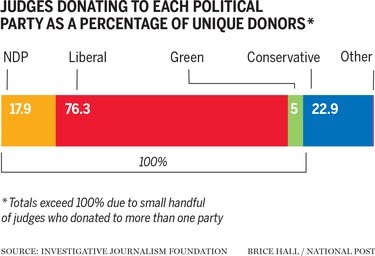
An eight-month investigation by National Post and the Investigative Journalism Foundation (IJF) of 1,308 judicial and tribunal appointments by the Liberal government since 2016 shows an overwhelming majority — 76.3 per cent — of appointees who had previously made political donations had given to the Liberal Party of Canada.


Wednesday, August 09, 2023

Mid-Week Post


Your middle-of-the-week's reflection ...


The nuclear attack on Nagasaki on Aug. 9, 1945, came three days after another atomic bomb was dropped on Hiroshima. It is believed to have killed around 74,000 people in the city by the end of the year and left many others suffering its effects for the rest of their lives.

A moment of silence will be held at 11:02 a.m., when the plutonium bomb code-named "Fat Man" was dropped by a U.S. bomber and exploded over the port city. It remains the last place to have suffered a nuclear bombing in wartime.


You don't say:

In late June, human rights lawyer Yavar Hameed filed a lawsuit asking the Federal Court to order the prime minister and justice minister to fill nearly 80 judge vacancies across provincial superior courts. Judicial vacancies have caused significant and growing court delays, which have “harmed” his vulnerable clients, Hameed said in his lawsuit.

Just weeks before, Supreme Court Chief Justice Richard Wagner wrote Justin Trudeau urging him to fill the “untenable” superior court vacancies. “The government’s inertia regarding vacancies and the absence of satisfactory explanations for these delays are disconcerting,” he wrote in a letter obtained by Radio-Canada.

Amid rising calls for the federal government to urgently fill judicial vacancies, court watchers are also pressing the government to reduce partisanship and be more transparent about who they are appointing to Canada’s courts.“ These long delays are symptomatic of the politicization of appointments, in the partisan and ideological sense of the term,” Patrick Taillon, professor of constitutional law at Université Laval, said in an email.

An eight-month investigation by National Post and the Investigative Journalism Foundation (IJF) of 1,308 judicial and tribunal appointments by the Liberal government since 2016 shows an overwhelming majority — 76.3 per cent — of appointees who had previously made political donations had given to the Liberal Party of Canada.

In comparison, just 22.9 per cent of appointees had given to the Conservative Party of Canada, and 17.9 per cent of those who donated gave to the New Democratic Party. Moreover, the number of Conservative donors appointed to the judiciary has dropped significantly since the Liberals came to power, whereas the number of NDP donors more than doubled between 2016 and 2022, the year the NDP entered an agreement to support the Liberals.


 Infographic of judges political donations


Oh, it gets better:

The Liberal government is having trouble finding a potential commissioner to oversee a possible public inquiry into foreign interference, with at least half a dozen current or retired judges having declined the offer, multiple sources have confirmed to the National Post.

The series of rejections over the last few weeks is further prolonging a process that has dragged out for six months since media reports alleged a significant and co-ordinated campaign of Chinese foreign interference in Canadian democratic institutions.


Can't Justin's uncle do it?

**

Conservative MP Michael Chong has once again become a target of what the federal government suspects is a targeted misinformation campaign backed by China.

Global Affairs Canada’s Rapid Response Mechanism, a program the government set up to track misinformation, identified the campaign against Chong happening on the social media app WeChat between May 4 and May 13, during recent federal by-election campaigns. The by-elections did not involve Chong directly, but his Conservative party did compete.

Global Affairs found a network of accounts spreading false or misleading information about Chong. It found a third of the accounts likely have some link to the Chinese government, while two-thirds of the accounts were anonymous and had not previously promoted news stories about Canadian politics.

The accounts also seemed to be co-ordinated, pushing the information out at roughly the same time, increasing the chance that WeChat users would see it.

“Most of the activity centred on spreading false narratives about his identity, including commentary and claims about his background, political stances and family heritage,” according to a statement from the government.

Chong has been an outspoken critic of the Chinese communist government in Beijing. He pushed for Parliament to adopt a resolution describing the treatment of Uyghurs as a genocide. Earlier this year, it was revealed CSIS had information that the Chinese government was collecting information about Chong’s family in Hong Kong, which was not initially shared with him

Chong has also said he has informed CSIS about direct threats he has received  that he believes are from the Chinese government.

Chong also advocated for the government to expel Zhao Wei, a Chinese diplomat accused of being involved in that operation. The government eventually expelled Zhao in May, after months of calls from the opposition to take that step.


Quebec is special:

Quebec Superior Court has the jurisdiction to hear a case calling on Gov. Gen. Mary Simon to be removed from her post because she cannot speak French, according to a Quebec Superior Court judge.

The Attorney General of Canada had tried to argue that only the federal court could look into such a case, but Judge Catherine Piché rejected the claim in June.

The court challenge, filed in Quebec Superior Court last summer, argues that Simon, who took over as the Crown's representative in Canada in 2021, cannot hold the position because she does not speak French —  one of the country's official languages.

The plaintiffs, a group of Quebecers, would like to see Simon's appointment invalidated.

**

A Christian group is suing the Quebec government for blocking a religious gathering last June at a publicly owned convention centre.

Tourism Minister Caroline Proulx cancelled the event weeks before it was set to take place at the Quebec City Convention Centre because she said the event would promote anti-abortion views.

British Columbia-based Harvest Ministries International filed a motion in Quebec Superior Court against Proulx, the convention centre and Quebec's attorney general.

The lawsuit argues that the cancellation of the 10-day rally was a violation of the group's Charter rights to non-discrimination, and to freedom of religion, expression, opinion, and peaceful assembly.

The group is asking for more than $200,000 in compensation for moral and material loss, and for punitive damages.

Quebec’s human rights commission criticized the government's decision and reminded the province about the importance of freedom of expression, even for unpopular or controversial ideas.


Trust the Liberals to screw up their own censorship bill:

A group of news publishers and broadcasters has asked the Competition Bureau to investigate Meta’s move to block Canadian news content from Facebook and Instagram.

News Media Canada, the Canadian Association of Broadcasters and CBC/Radio-Canada want the Competition Bureau “to use its investigative and prosecutorial tools to protect competition and prohibit Meta from continuing to block Canadians’ access to news content.”

The company began blocking news on its platforms last week in response to the Liberal government’s Online News Act. The law would force Meta and Google to reach commercial deals with news publishers to share revenues for news stories that appear on their platforms. (Postmedia, publisher of the National Post, is in favour of the legislation.)


No one wants Canadian news and even Justin and the Argentinian creep know it.

It is about censorship.


A trip down memory lane:


Justin has no intent on reaching NATO's required two percent defense spending.

Under him, Canada is not a serious country.

The world has noticed:

Critics of Canada’s lax defence spending keep piling on, most recently Alaska Senator Dan Sullivan who, during a hearing on the new commander for Norad, said, “Americans are frustrated when our allies don’t pull their weight. With regard to NATO, Canada is not even close.”

Sullivan’s comments came on the heels of a stinging Wall Street Journal editorial labelling Canada as a “military free-rider in NATO,” adding that we see our membership largely as “a place to rub elbows with global powers and a platform for moral pronouncements.”

A communiqué from the recent NATO summit in Lithuania stressed that the alliance’s funding target of two per cent of GDP is no longer merely aspirational but a minimum requirement to be considered as a “member in good standing.”
It was reported earlier this year that Prime Minister Justin Trudeau privately told NATO officials he didn’t think Canada would ever hit the two per cent target. He has reportedly pled for the alliance to broaden its definition of military spending to include research on space, cyber security and AI, but, not surprisingly, his proposal has gained no traction.
The WSJ suggested the Trudeau government sees its military as “more of a social project than a fighting force.” It cited the prime minister’s mandate letter to the minister of national defence in December 2021: “Your immediate priority is to take concrete steps to build an inclusive and diverse Defence Team, characterized by a healthy workplace free from harassment, discrimination, sexual misconduct and violence” — in fact a cultural manifesto that had nothing to do with military capability.

Article content

At a time when NATO celebrates the addition of Finland and Sweden to the alliance and there is steady progress in Ukraine’s valiant fight against Russia, Canada’s pathetic contribution is more exposed than ever. Our spending of about 1.3 per cent of GDP on defence falls well below the 2.0 per cent commitment and ranks sixth from the bottom in the 31-member alliance.


Was it someone they trampled?:

Fewer than half of Canadians surveyed consider the RCMP accountable, says in-house research. The findings follow the resignation of Commissioner Brenda Lucki: “They award lower marks when it comes to the calibre of its leadership.”


Also:

An audio recording was posted to social media last week of a Calgary police officer telling a Canadian Muslim man organizing protests against LBGT indoctrination in schools that the white Canadians protesting alongside him secretly “hate Muslims” and are “white supremacists.”

In the audio recording, published August 3, Calgary Police Service officer Matt Messenger can be heard telling Mahmoud Mourra, the organizer of Muslim-led protests against the LBGT agenda being taught in schools, that white Canadians and supporters of the Freedom Convoy are “white supremacists” and will “turn their back to you.”  

“This policeman blames and accuses the white people and Freedom Central of being troublemakers and racists,” Mourra wrote on a Facebook post. “Pay attention to his ‘advice’ when he promotes hate and division in our society, and how he threatens us.”


It's called a shakedown:

Calling it “no way to start a conversation,” Alberta Environment Minister Rebecca Schulz fired back against a new federal policy paper that indicates Ottawa is considering tying some tax credits and funding for provinces to meeting its 2035 deadline to create a non-emitting electricity grid. ...

The incentives include tax credits for hydrogen, carbon capture, and clean technology as well as $3 billion in grants for renewable electricity projects.
In an interview with Postmedia, Schulz said the federal scheme amounts to more than a simple incentive.
“Coming out with a veiled, or just a straight-up threat that if provinces don’t sign on to a net-zero grid by 2035, that they’re not going to be able to access these tax credits … that’s no way to start a conversation,” Schulz said.
“We just can’t allow the federal government to drive up the cost of power for Albertans or put at risk the integrity of our power grid.”


Net Zero is a myth, by the way.


It doesn't work:

Again echoing the NDP, Unifor has also lamented high grocery store prices, to which unionization and strikes undoubtedly contribute by inflating costs and reducing supply. It is an error, too, to say higher wages and lower food prices can simply be paid for by reducing profits. Metro’s 2023-Q2 results report its past eight quarters of earnings; in each quarter net earnings were less than five per cent of sales. And that significantly overstates its food margins: in addition to its 975 food stores Metro also operates 645 pharmacies, and margins in pharmacies are much higher than in the grocery stores.

While business competition makes things better for workers and consumers alike, labour unions invariably stand in the way of affordability and competition, and as Hayek said, rely on government privilege and coercion of employees for survival. Many Metro workers may well want to accept the latest company offer, which includes improved benefits and wage increases that outpace inflation, but the union strikes prevent them from returning to work. It is difficult to see how this coercion of some workers by other workers is beneficial or compensates for rising consumer prices and lost economic output.


I'll just leave this right here:


Yes, but that would enfranchise them, as it would other Canadians, and the government simply will not have that:

Many Indigenous communities in Canada are in crisis because of a severe shortage of adequate housing. According to a forthcoming study by the Assembly of First Nations and Indigenous Services Canada, First Nations reserves require $135 billion to address this deficiency. And that doesn’t include housing shortfalls in Métis settlements and Inuit communities, which could push the total need much higher. ...

An underappreciated cause of this crisis is Indigenous families’ inability to own their own homes, in part because reserve land, whose title belongs to the Crown or the First Nation, cannot be pledged as collateral for housing loans. But it’s also because the housing subsidized by the federal government in these communities has primarily been social housing. In the rest of Canada, in contrast, the government promotes personal homeownership with government-subsidized mortgage insurance, home-buyer saving plans and other policies. Homeownership is generally viewed as good for community well-being and social stability. As a result, approximately 70 per cent of families in the rest of Canada own their homes. In most Indigenous communities, however, the rate of homeownership is effectively zero.


Wow.

In Canada, he would have a cabinet position by now:

The deputy mayor of Tokyo's Shibuya Ward resigned on Tuesday after facing criticism for mocking a female local assembly member, referring to her as "pig" in an online workplace chat.

Shin Sawada, 63, issued a statement apologizing to Yukiko Kuwazuru, a 35-year-old rookie ward assembly member, for his "inappropriate" posts that "severely damaged" the municipality's reputation.


China and Russia have always been North Korea's allies and have always used their positions on the UN security council to shield it:

An unusual sighting of a Russian military jet in North Korea is stoking concern that Kim Jong Un is selling Vladimir Putin weapons as ties strengthen between the sanctioned states. ...

The journey by the Russian Air Force jet came just days after Defense Minister Sergei Shoigu traveled to Pyongyang on a similar plane to attend a military parade hosted by Kim, who also gave him a tour of a weapons exhibit. It “appears related to following up on Shoigu’s delegation visit and possibly agreements made with Kim,” NK News said, adding that analysts “speculated that the two could have made weapons deals.”

North Korea has been trying to revive its economy, largely by resuming trade with China and evading international sanctions. Russia recently restarted oil shipments to North Korea for the first time since 2020, the United Nations has said, following the earlier resumption of grain exports. It is impossible to know what North Korea is sending in return but both the U.S. government and independent analysts suggested munitions from the stockpiles North Korea has built up amid tensions with Seoul.


Also:

In spite of lingering claims about “Ukraine fatigue” in the West and the stalled discussions on Kyiv’s possible future membership of NATO, the United States and Europe are stepping up their arms provision to Ukraine and strengthening commitment in the long-term.


On the other hand, concerns are arising over the U.S. strengthening its involvement in Ukraine, with some criticizing the move as having a negative impact on Washington's capability to deter and address a possible contingency involving China in the Indo-Pacific region.

Simply put, the question is which should be given priority as a threat and challenge that needs responding to — Russia or China. As long as there are limits to U.S. resources, there is no denying a tradeoff.


The paper tiger's economy is faltering:

China's consumer prices fell into deflation in July, while factory gate prices extended their declines, as the world's second-largest economy struggled to revive demand and pressure mounted for authorities to release more direct stimulus.

The consumer price index (CPI) for the month dropped 0.3% year-on-year, the National Bureau of Statistics (NBS) said on Wednesday, a slightly slower fall than the median estimate for a 0.4% decrease in a Reuters poll. It was the first year-on-year decline since February 2021. CPI was unchanged in June.

The producer price index (PPI) fell for a 10th consecutive month, down 4.4% from a year earlier after a 5.4% drop the previous month. That compared with a forecast for a 4.1% fall.

China's economic recovery slowed after a brisk start in the first quarter, as demand at home and abroad weakened. Authorities have rolled out a flurry of policy measures to support the economy, with more steps expected.


Also:

Taiwan's defence ministry said that starting at around 9 a.m. (0100 GMT), it detected a total of 25 Chinese aircraft engaging in operations out at sea, including J-10 and J-16 fighters, as well as H-6 bombers.

Of those aircraft, the ministry said 10 had either crossed the median line of the Taiwan Strait, which previously served as an unofficial barrier between the two sides, or entered the southwestern part of Taiwan's air defence identification zone, or ADIZ.


And:

More than a quarter of Chinese diplomats assigned to a Toronto Consulate have left the country since the last general election, data show. Figures on accredited staff were updated yesterday for the first time since the expulsion of a Chinese spy: “It does make me wonder.”

**

China is behind many money-laundering transactions and other fraudulent financial activity in Canada, according to a July report from the Financial Transactions and Reports Analysis Centre of Canada (FINTRAC).
The report identified students, homemakers, lawyers, and business owners as some of the occupations involved in receiving funds from China.